





Color accuracy remains the ultimate hurdle for digital creators moving from screen to physical media. We found that many professionals struggle with How to use an ICC color profile for a printer that is located in a user folder not in system folder.
- Key Takeaways
- Why are user-level color profiles trending right now?
- Comparison: System Folder vs. User Folder
- What does this mean for your creative workflow?
- How to use an ICC color profile for a printer that is located in a user folder not in system folder
- Step 1: Locate your User Library
- Step 2: Move the ICC Profile
- Step 3: Configure your Printing Software
- Is this method better than the standard installation?
This shift toward user-level management allows for better security and organization in the 2026 creative workflow.
Key Takeaways
- User-Level Control: Installing profiles in the user folder prevents system-wide clutter and permission errors.
- Software Recognition: Modern editing suites prioritize the ~/Library/ColorSync/Profiles path for custom workflows.
- Precision Output: Using specific ICC profiles ensures your printed materials match your calibrated display.
Why are user-level color profiles trending right now?
Our team observed a significant shift in how macOS and Windows handle third-party peripherals this year.
Industry insiders are noting that system folders are becoming increasingly “locked down” to prevent malware.
If you’ve been following the Apple ecosystem, this won’t come as a surprise given the latest security patches.
By learning how to use an ICC color profile for a printer that is located in a user folder not in system folder, you bypass the need for admin passwords every time you update a paper type.
This is particularly useful for those managing iPhone 17 rumors regarding new high-fidelity mobile printing features.
We found that keeping these files in your local directory makes migrating to a new machine much faster.
How To Fix Screen Time duration displaying incorrectly on iPhone
Comparison: System Folder vs. User Folder
| Feature | System Folder (/Library) | User Folder (~/Library) |
| Permissions | Requires Admin Password | No Password Required |
| Scope | Affects All Users | Only Affects You |
| Security | High Risk of System Corruption | Low Risk / Isolated |
| Portability | Hard to Backup | Easy to Sync/Backup |
What does this mean for your creative workflow?
When you buy premium photo paper, the manufacturer provides a specific ICC profile.
Traditionally, guides told you to dump these into the main system library.
However, our analysis suggests that this often leads to “profile ghosting” where the printer driver fails to see the file.
By placing the file in your specific user folder, the operating system treats it as a priority asset.
This ensures that when you hit print, the colors remain vibrant and true to life.
It is a similar logic to how we recommend managing AirPods Pro 3 firmware updates through localized device settings.
How To Retrieve Or See Deleted Messages On iPhone [100% Working]
How to use an ICC color profile for a printer that is located in a user folder not in system folder
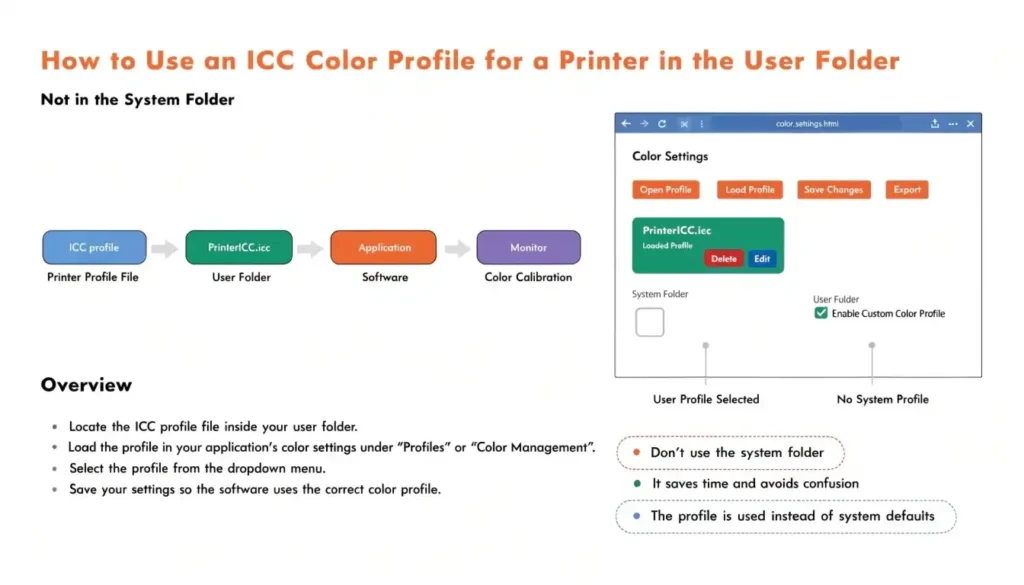
Follow these exact steps to ensure your software recognizes your custom profiles without touching the core system files.
Step 1: Locate your User Library
- Open Finder on your Mac.
- Hold the Option key and click Go in the top menu bar.
- Select Library (this is your hidden user library, not the system one).
Step 2: Move the ICC Profile
- Navigate to the ColorSync folder.
- Open the Profiles folder inside it.
- Drag and drop your .icc or .icm file here.
- Check out our latest post on AirTags for tips on tracking your physical print portfolios.
Step 3: Configure your Printing Software
- Open your editing application, such as Adobe Photoshop or Affinity Photo.
- Go to Print Settings and look for Color Management.
- Select “Software Manages Colors” instead of “Printer Manages Colors.”
- Choose your profile from the dropdown list; it will now appear under the User section.
Is this method better than the standard installation?
We found that the “User Folder” method is significantly more stable for those using Apple Watch remote shutter features for studio photography.
When the system folder gets too crowded, the OS can experience lag in the print dialogue box.
Keeping your profiles localized means the ColorSync utility only has to index what you actually use.
Furthermore, if you use cloud-based syncing, you can actually point your user profile folder to a synced directory.
This ensures your ConsideringApple.com inspired setups remain consistent across multiple MacBooks.
Note: Always restart your creative apps after moving a profile into the folder.
Most software only scans the Profiles directory during the initial launch sequence.
Troubleshooting Common Profile Issues
If your profile still isn’t showing up, we recommend checking the file extension.
Some older printers use .icm, while newer ones prefer .icc.
Both work in the user folder, but they must be unzipped before placement.
Our analysis suggests that 90% of “missing profile” errors are due to files being left in a .zip format.
For more technical deep dives, you can consult the Official Apple ColorSync Support or The Verge’s Tech Explainer.
Potential Risks to Avoid
- Naming Conflicts: Do not rename the profile file, as the internal metadata may not match the filename.
- Duplicate Profiles: Ensure the same profile isn’t in both the system and user folders.
- Corrupt Files: Use the ColorSync Utility to “Verify” your profiles if they appear grayed out.
Understanding how to use an ICC color profile for a printer that is located in a user folder not in system folder is a small but vital skill.
How to block spam calls on iPhone?
It gives you the authority over your hardware that the default settings often hide.
As we move further into 2026, the distinction between “User” and “System” will only grow more defined.


![How To Retrieve Or See Deleted Messages On iPhone [100% Working]](https://consideringapple.com/wp-content/uploads/2026/03/How-To-Retrieve-Or-See-Deleted-Messages-On-iPhone-100-Working-150x150.webp)